What we tell you before we start.
A restoration runs in a set order, with the care built into each step. Here is the whole job as it actually goes — including the honest parts most of the trade only mentions afterwards, if they mention them at all: what we do, what can turn up, and what we do about it when it does.
Five steps, in order.
The assessment
We walk the surface with you — joints, base, drainage, edges, and a scratch test on the old sand. What we find prices the job in writing before anything is booked.
Extraction and wash
The failed sand comes out of every joint, and the surface gets washed with the pressure chosen per step: a soft wash for the face of the stone, more only where a joint has to empty, and heat instead of force against the house.
The wait
The surface has to be bone dry before new sand goes in, and the sand day itself waits for the weather. If the forecast is wrong, the day moves. A little patience here is what a joint that lasts is made of.
Re-sand and compaction
Premium polymeric sand goes in and the plate settles it solid, a protective pad riding between machine and stone. Poured sand bridges partway down a joint; compaction is what fills it for real.
What we tell you along the way
Anything the work uncovers — a stone with an old fault, a low spot the wash mapped, parging past its best — you hear about the day we find it, and it is priced with you before more work happens.
The rest of this page is that last step in full — known in advance, so nothing about your own driveway arrives as a surprise. None of it is common, and none of it is fine print.
New sand waits for a proper window.
Polymeric sand is particular about its first day. It goes into joints that are dry to the bottom, gets watered once to set, and then needs the sky to leave it alone while it cures. Rain in the wrong hour washes uncured polymer across the face of the stones and leaves a joint that firmed up on top before it ever set underneath.
So the sand day is booked against the forecast, not the calendar. If the window is not there — damp joints, rain coming, or temperatures the polymer cannot cure in — the day moves, and you hear from us rather than finding out from the weather. That can add days between the visits. It is also the job going right: the wait costs nothing, while sand installed in the wrong conditions is paid for twice.
Some stones are already cracked when we get there.
A concrete paver can carry a crack for years without showing it. Hairline, inside the stone, running out from an edge or from an old chip that filled in with grime. What holds it together is friction — the joint sand packed against both sides and the weight of every stone around it.
A restoration takes that bracing away. Every old joint comes out — that is the whole point of the job — and the moment they do, each stone loses the support it has had for years. Then the surface is washed. Then a plate compactor runs over the new sand. Neither step is rough treatment. Either one is enough to finish a break that was already there.
So it happens. Not on most jobs and not on most stones, but often enough that pretending otherwise would be dishonest.
You will hear about it the day it happens, with the piece in hand. Not on the invoice, and not left for you to find.
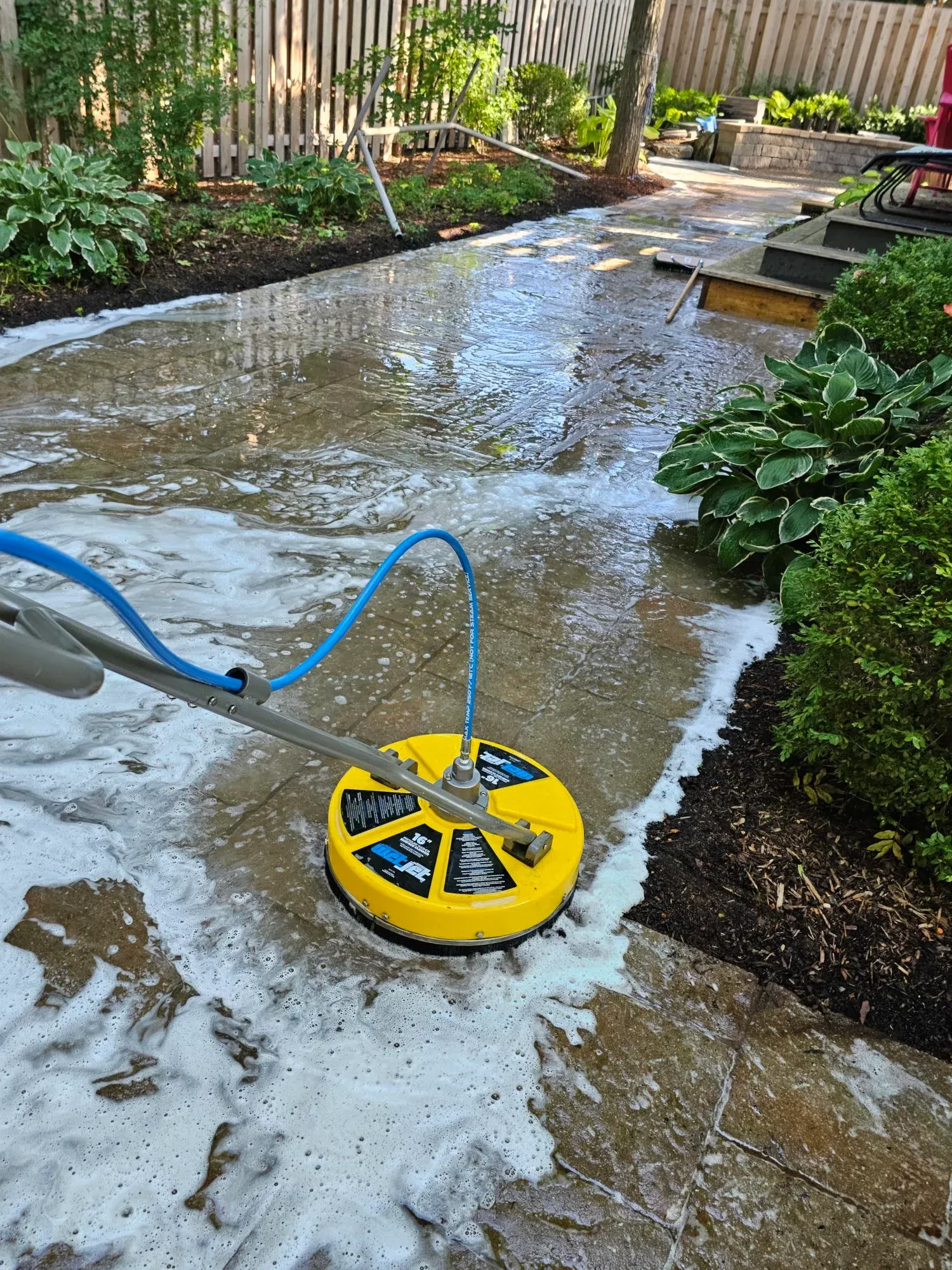
What we do about it
Pressure is chosen per step, not left wherever the machine happens to sit. Washing a surface is a soft wash — generally under 400 psi, agitating up to 1,250 where something has really set into the stone. The number only climbs when material has to come out. Emptying a joint of hardened polymeric sand takes the working pressure that job actually requires, under 3,500 psi: high enough to clear the joint, controlled enough to leave the stone alone.
Then the plate follows, with a polyurethane pad fitted between the steel and your stones on every re-sand. None of that makes a stone with a fault inside it sound. It just means nothing we bring to your driveway is what put the fault there.
What we do not do is absorb it
A stone that splits along a crack it already carried is not damage we caused, and replacing it is not included in the price of the restoration. A paver manufacturer's own warranty will tell you the same thing — compaction damage is specifically excluded.
We are telling you this on a page you can read before you book, which is the only time this information is actually useful.
Parging is the fragile part of the job.
Where interlock runs right up against the house, the last joint sits against the parging — the mortar skim over your foundation wall. Old polymeric sand bonds to it. Getting that sand out is the part of an extraction that asks for the most care, because parging was never built to take pressure and a good deal of it in this city is already tired.
So the method changes at that edge. The pressure comes down further than anywhere else on the surface, and heat does the work instead of force — steam softens the old sand until it can be worked out rather than driven out. It is slower, and it is the only way we know to take a joint apart against a wall without taking the wall's coating with it.
And the honest part: parging that has already lost its grip on the block behind it will come away no matter who is working next to it or how carefully. That is not damage done on the day. It is a repair that was already owed, simply turning up on the one day there is finally someone standing next to it.
A clean surface tells the truth about itself.
Fifteen years of grime is also fifteen years of cover. Taking it off is what you are paying for, and it is also the moment a surface stops hiding things. None of what turns up was made by the wash. It was made by the fifteen years.
Efflorescence
A white haze that is not dirt. Mineral salts inside the stone dissolve, travel up through it with moisture and dry on the face — it comes out of the paver rather than landing on it. A wet spring brings it on. So can a wash. It has its own treatment and no cleaner takes it off.
The colour underneath
Clean is not new. What comes back is the stone as it actually aged: sun on the open faces, shade under the tree, a darker run where the car sits. If part of your driveway spent ten years under a deck, you are going to see that once the grime is gone.
The texture is the age
Traffic polishes the high points and weather opens the face. The top couple of millimetres of a fifteen-year-old paver are not what left the factory, and washing does not put that back. What a wash removes is what is sitting on top of the stone.
Old chips and knocks
A corner off, a shovel mark, a spalled face. All of it was there under the moss. It becomes visible on the same day the surface gets cleaned, which makes the clean an easy thing to blame.
The other thing a wash exposes is where the ground has moved, because water collects in every low spot whether or not anyone thought it was level. That one is worth money to you: it is a free survey of your surface, drawn to scale, and it is why the scope of a repair sometimes grows after the clean. The long version is on Interlock Lift & Relay.
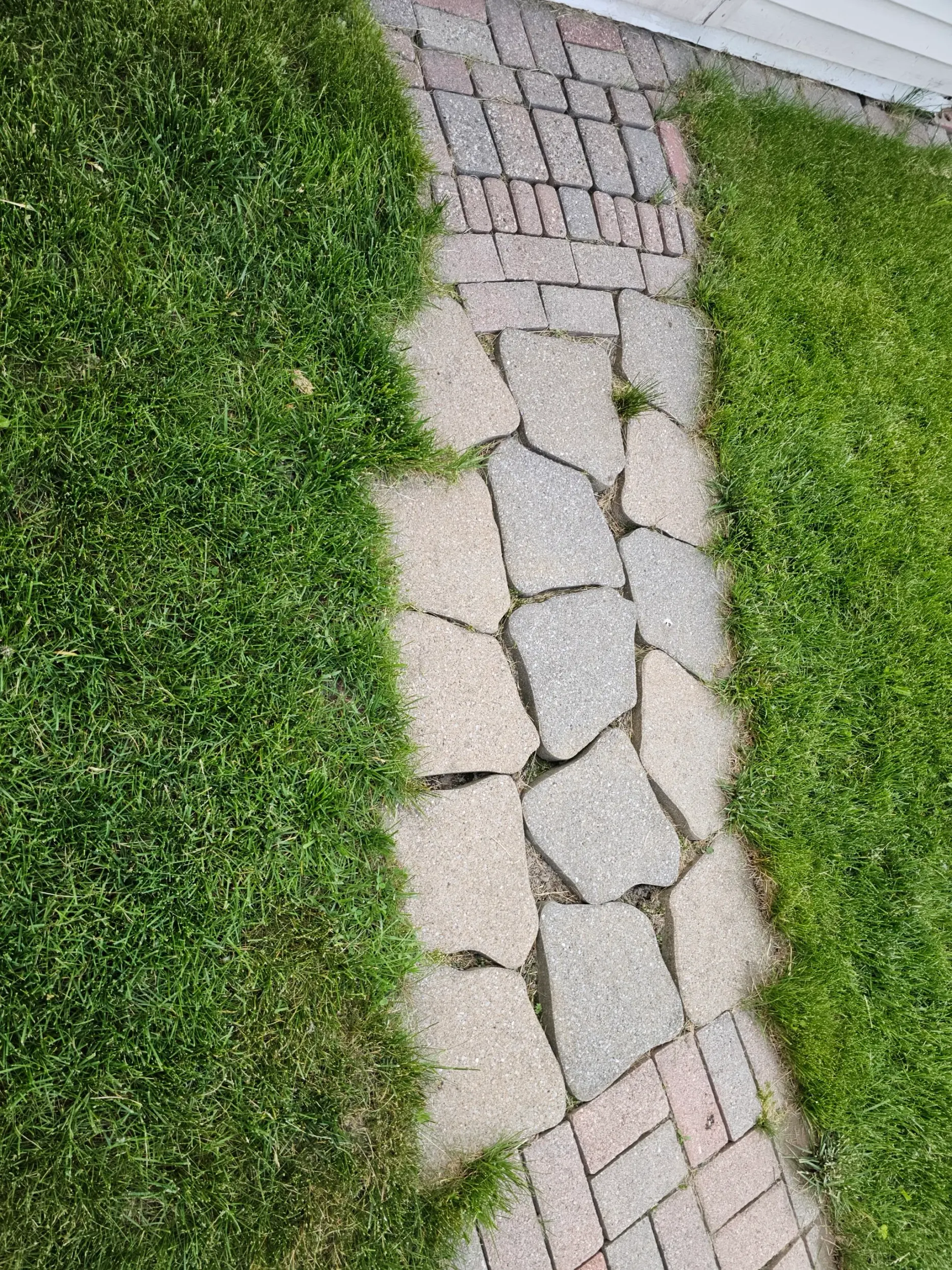
We work on top of ground we did not build.
Frost in eastern Ontario goes deeper than any paver base. Foundations and roads around Ottawa are designed for it reaching well past a metre — far below the gravel under your patio. So the ground beneath every interlock surface in this city freezes, lifts and settles back every winter, and has done since the day it was laid.
Where it lifts evenly nobody notices. Where it lifts unevenly you get the dips and the lippage: one corner drains and another holds water, a root runs under one section, a downspout has been feeding the same square metre for six years. The industry's own maintenance guidance puts it in one line — heaves are typically caused by frost heave of the soils underneath.
That layer is not something a restoration builds, and it is not something a restoration can warrant. What we can do is correct the bedding where it has moved, while the joints are already out, and say plainly when the problem runs deeper than bedding. Where a surface is failing because the base was never right, you will hear that instead of a quote.
Salt
Pavers made to the Canadian standard are freeze-thaw tested sitting in a salt solution, which tells you what the industry expects them to face here. It does not make them immune. De-icer keeps a surface wet longer, and a stone that goes into a freeze saturated is the one that scales. Sealed or not, what goes down in January shows up in what the surface looks like in April.
A web page is not a contract.
Everything here also appears on your proposal, because that is the document that decides anything. This page exists so none of it reads as fine print when you get there.
And none of it is a way out of doing the work properly. What we stand behind is our own work, and that side of the line is set out on the Annual Maintenance & Warranty page. This is the other half of the same conversation — the part a restoration does not control, said out loud instead of left for you to find.
Questions this raises.
If a stone cracks, do you replace it?
We tell you the day it happens and we show you the piece. Whether it gets replaced is your call, because replacing one is rarely simple: a paver that has been in the ground fifteen years does not match a new one off the pallet, and the honest fix is usually to borrow a stone from somewhere out of sight — under a step, along a hidden edge — and put the new one there instead. Some owners want that done. Plenty look at a hairline in a driveway of four thousand stones and would rather leave it. Either answer is fine. We prefer to be transparent about it.
Then why compact at all?
Because sand poured into a joint bridges — it lodges partway down and holds the rest up, so a joint that looks full is sitting half empty underneath, and that crust cracks within a season. Vibration is the only thing that drives sand to full depth. Skipping it is how a re-sand fails in its first year. The trade-off is real, and we take the side that leaves you with joints that last.
Does any of this void my warranty?
No. These are conditions of the surface, not failures of the work. The joint warranty covers the joints we install, and it is unaffected by a stone that split along a fault it already carried or by efflorescence coming out of a paver we did not make. Where something we find does affect coverage — a sunken area you would rather not correct, for instance — you hear that at the assessment, in writing, before anything starts.
What if it rains before the sand day?
Then the sand day moves, and we tell you the day before rather than on the morning. Joints have to be dry to the bottom and the sand needs clear weather to cure — put it down ahead of rain and the surface you paid for streaks while the joint underneath stays soft. The forecast decides the date; the work does not change.
Is this a list of things you will not fix?
It is a list of things nobody can promise away, written down before you book instead of explained after. Most of them we can do something about, and the page says what. The ones we cannot — what frost does to the ground, what a decade of sun did to the colour — are worth knowing about anyway, because they are the difference between a surface that disappointed you and a surface that behaved exactly as it was always going to.