Some repairs only make sense while the joints are out.
Lifting the stones, fixing what is underneath, and re-laying them flush is part of a restoration rather than a separate job. Once the joints are gone, the surface is already open — and that is the cheapest access you are ever going to get.
The window opens once, in the middle of the job.
A restoration starts by removing every old joint. Until that happens the stones are locked together — that interlock is the whole point of the surface. Once the joints are out, the lock is released and a section can be lifted by hand, worked on, and put back.
This usually takes a few hours in the middle of a job we are already on site for, with the equipment already unloaded. Booking the same repair on its own later means emptying those joints all over again. So while the surface is open, we look at what is underneath and tell you what we find.
Small repairs and large ones both live in that window. What decides which is what the bedding has been doing while nobody could see it.
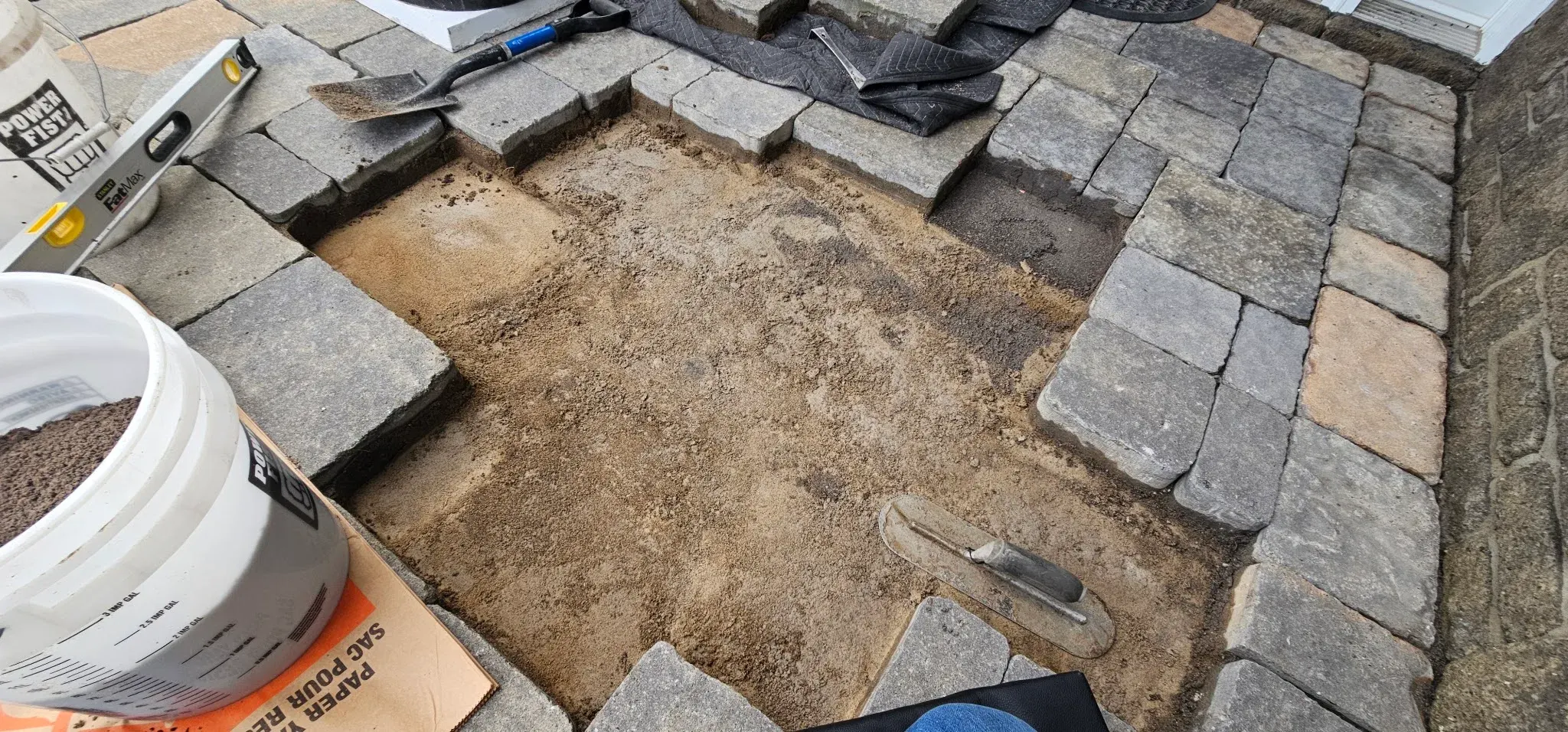
What a lift and relay actually fixes.
Pricing is driven by what the base needs, because that is what decides the hours. Published Ottawa rates for this kind of work usually run $10–18 per square foot — that range covers our standard relay tier. Where the gravel structure itself has failed, the honest name for the job is a rebuild, and that is not work we sell — you will hear it plainly at the assessment instead.
A dip you can see from the driveway
The most common one. A low spot that holds a puddle after rain, usually where a downspout lands or where a joint went open years ago. The stones are fine — what moved is the bedding underneath them.
Bedding that has gone soft
Where water has been getting in for a few seasons, the bedding stops behaving like a firm layer. You feel it before you see it: the surface gives slightly underfoot, and the stones no longer sit tight against each other.
Stones that rock or catch a toe
A paver that moves under weight, or a lip between two stones high enough to catch a foot or a shovel. Both are bedding problems wearing a surface disguise, and both get worse once winter finds them.
Edges that have crept outward
Without a restraint holding them, perimeter stones migrate a little every year and the joints behind them widen to follow. Re-setting the edge and restraining it properly is what stops the rest of the surface unravelling.
A root running under the surface
A tree root lifting a section is not something joints can absorb. Lifting the stones shows how far it runs and whether the surface can be re-set over it or wants a different approach entirely.
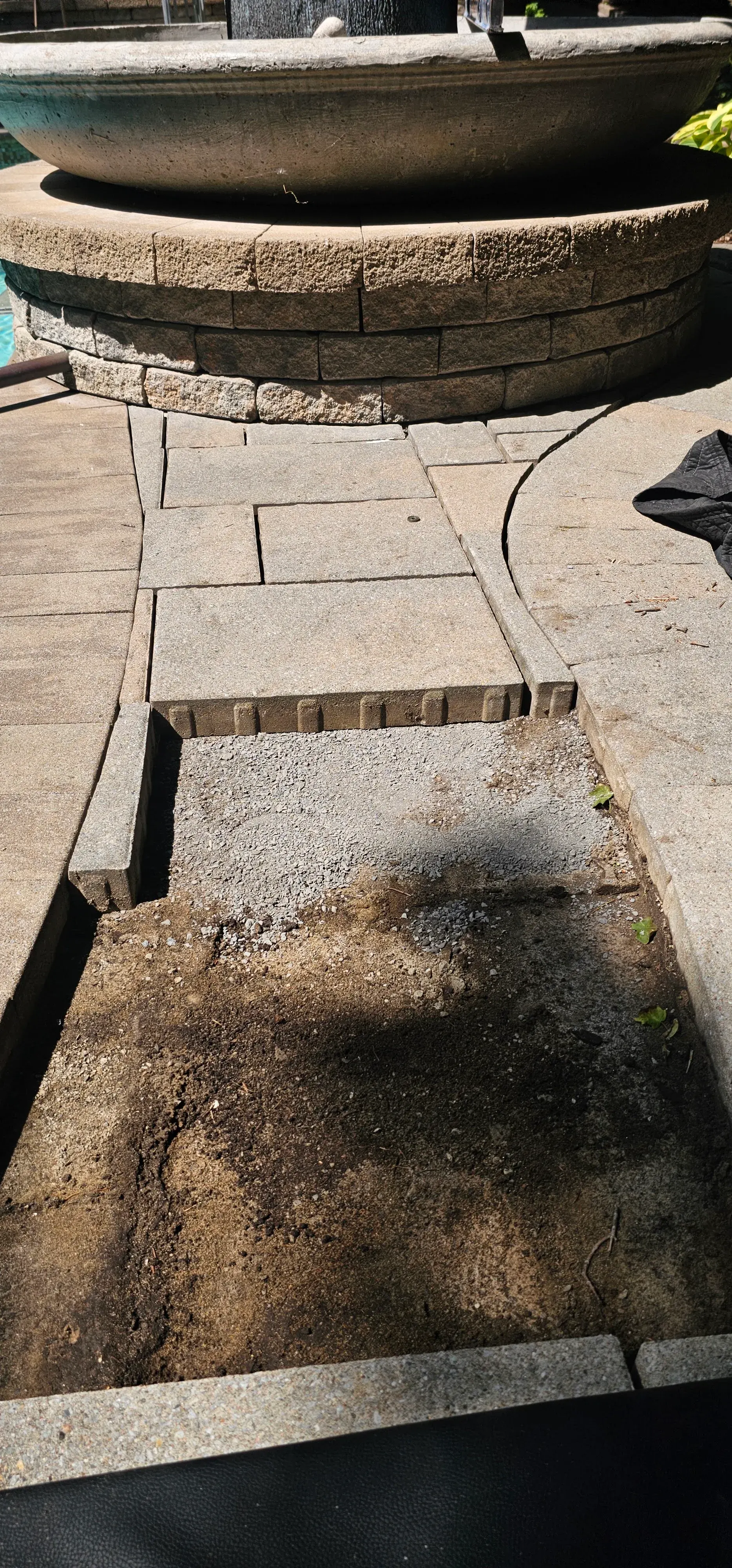
A few stones, or a whole section.
Three things decide how big it gets: what the surface is actually doing, how flat you want it, and what turns up once the stones are clean.
Small is the usual case: a handful of pavers around one settled spot, lifted, the bedding brought back to level, everything re-set flush. It folds into the restoration and is finished the same day the joints are.
Larger means the area comes up as a section — the bedding re-screeded across it properly, and where the old material has broken down, replaced rather than raked back into shape. That is a bigger piece of the day and it is quoted as one, before it starts.
The edge is its own case. Perimeter stones with nothing restraining them drift outward year on year, and every joint behind them widens to take up the slack. Re-setting an edge without restraining it properly is work that comes undone.
Then there is the standard you want. "Flat" is not one thing. Some surfaces only need the trip lip gone and the puddle drained — once that is fixed, the owner is happy. Others are meant to read completely level across the whole run, which means lifting well past the original problem area. Neither answer is automatically right. It is a conversation worth having before the work starts rather than after.
The wash is the survey.
A restoration always cleans the surface before the joints come out, and cleaning changes what you can see. That is the honest reason a lift and relay sometimes ends up bigger than it looked at the assessment.
Dirt hides the shape of a surface
Moss, ground-in grime and a decade of haze flatten out what your eye can read. Lippage between two stones disappears under it, and so does a slow dip across a run. Wash it and the same surface tells you things it was not telling you an hour earlier.
Water finds every low spot
Pressure washing puts a lot of water on the surface, and water does not care what anybody thinks is level — it collects wherever the ground gave way. The puddles that appear during the wash are a map of the settlement, drawn to scale, for free. There is no better survey of a paver surface than watching it drain.
So we confirm the scope after the clean
We flag what we expect at the assessment, and we confirm it once the surface is washed and we can both look at the same thing. If it turns out bigger, you hear it then — with the puddles still on the ground to look at — and you decide. It never turns up as a line on an invoice.
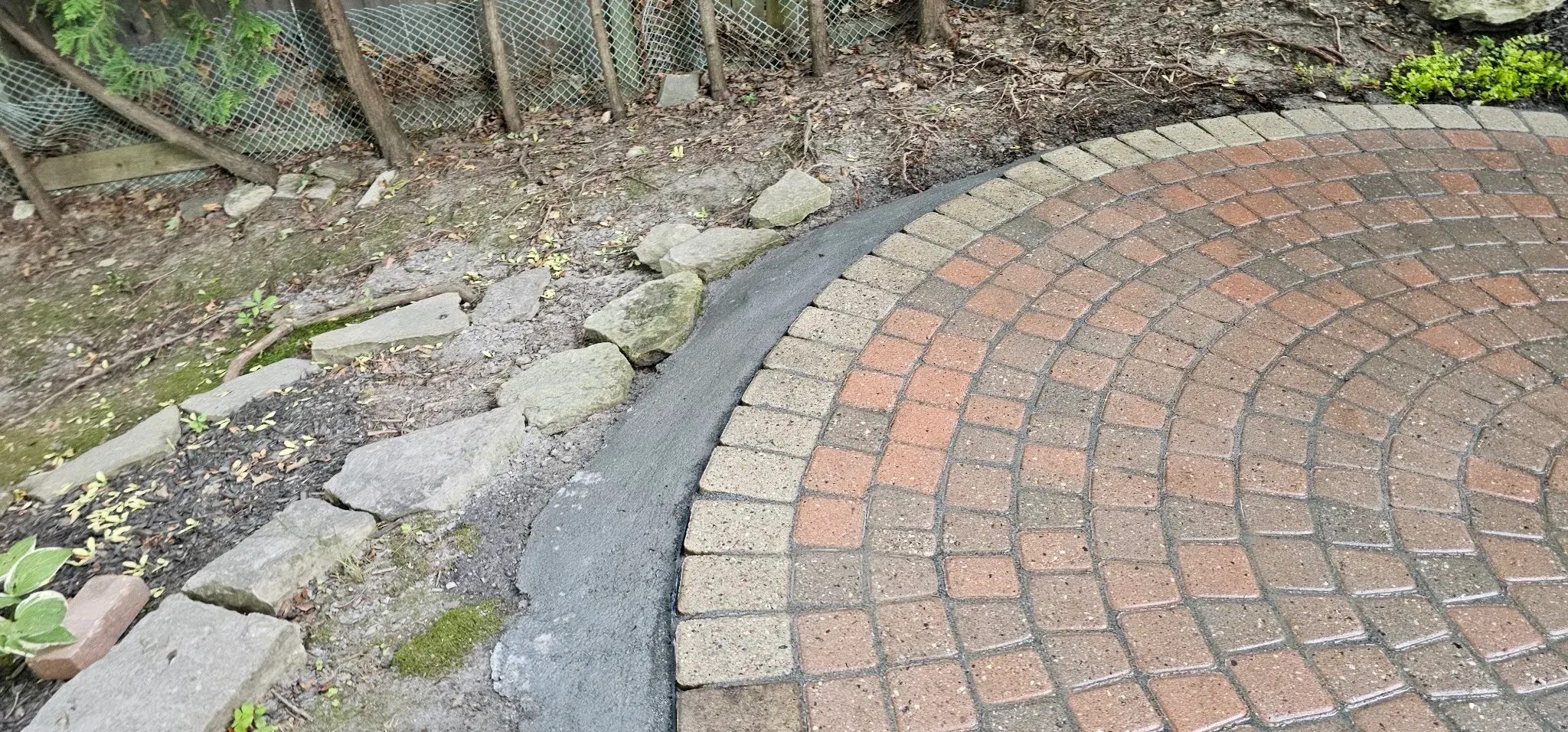
When it is not the answer.
Lifting and re-laying corrects the bedding — the layer the stones sit in. It does not rebuild the base underneath, and it is not meant to. Where a surface is heaving across a wide area, or was laid over ground that was never going to support the load, re-setting sections only buys time, and the cost starts to approach doing the job properly.
You will hear that at the assessment rather than after the invoice. It is a shorter conversation, it may cost us the work, and it is the only version worth having.
There are honest bands further down, and the exact figure still comes from the free assessment — scoped in writing, phase by phase, and quoted with the restoration.
What decides the number is the base, not the negotiation.
Published Ottawa rates for lift-and-relay work run $10–18 per square foot. Ours are built up from real labour and material costs, phase by phase, and most projects land inside the band below.
Only when a restoration has already freed the stones — the joint extraction did the heavy part, so there is no break-out labour left to pay for.
The base still holds its grade. Stones up, bedding topped up and re-screeded, everything re-set flush. This is the common one.
The exceptions: re-pitching a section that drains the wrong way, heaved or washed-out runs, collapsed edges, heavy slab formats, tight access. Where the problem runs deeper than the bedding — a failed gravel base — we say so at the assessment instead of quoting.
If the base itself has failed, there is no tier for it — on purpose. Excavating and rebuilding the gravel structure is closer to a new installation than a repair, and installation is not what we sell. What you get from us in that case is the assessment itself: what failed, why, and what the honest options are. Advice from someone with nothing to sell you on the other side of it is the point of the visit.
Timing moves the number more than negotiating does. Every restoration begins by taking the old joints out, and once they are out the stones lift freely. Work done inside that window skips the most labour-intensive step, which is the whole reason the re-set tier exists — and it is why that tier is not available on its own.
Small areas cost more per square foot, not less. The trip, the unload and the setup are the same whether we lift forty square feet or four hundred, and a patch cannot be screeded in long runs the way a section can. There is a $1,050 minimum on a visit booked for this work on its own, which is roughly where the hours stop covering the day.
All figures +HST, and they are bands rather than quotes. The exact number comes from the free assessment, in writing and phase by phase. If lifting the stones shows something the walk-through could not, it is priced with you before the work continues — never discovered on the invoice.
Common questions.
Is this a separate service I book?
No — it happens inside a restoration. Every restoration starts by taking the old joints out, and once they are out the stones are no longer locked to one another. That is the moment a section can be opened without breaking anything, so it is the moment repairs cost the least. Booking it on its own later means paying a second time for access you already had.
What does it cost?
By the square foot, and what sets the rate is the scope rather than the size. Re-setting stones a restoration has already freed starts from $8. A shallow re-level, where the base still holds its grade, runs $10 to $16 — that is most of this work. Complex jobs — re-pitching a section that drains the wrong way, heaved or washed-out runs, collapsed edges — run $16 to $22, which overlaps the top of the $10 to $18 published Ottawa rates. If the base structure itself has failed, that is a rebuild rather than a repair — not work we sell, and we say so at the assessment rather than pricing it. There is a $1,050 minimum on a visit booked for this work alone: the trip and setup are the same whether we lift forty square feet or four hundred. The exact number comes from the free assessment.
How do you know how far it goes until you open it?
Often we don't, entirely — and we say so rather than pretending otherwise. The assessment tells us what is likely from the surface: where it dips, where it rocks, how the water runs, what the edges are doing. If opening it up shows more than that suggested, you hear about it before more work happens, not on the invoice.
Will the repaired area match?
The stones going back are your stones — lifted, cleaned and re-laid in the same pattern, so there is no colour mismatch to manage. What changes is what is under them. Once everything is flush the whole surface is jointed together with Techniseal HP NextGel, so the repair is not a visible patch in a field of older joints.
My driveway was built on stone dust — does that have to come out?
No. Stone dust is an acceptable standard for a surface that was built with it, as long as the installation is not a permeable one. We do not replace a stone-dust base because it is stone dust. What we look at is whether the bedding is still doing its job — if it has gone soft and the stones are moving, that is the same re-level as any other bed, and the material underneath does not change the answer. Permeable paving is the exception: it is open stone the whole way down precisely because it has no fines to lose, so stone dust does not belong in one.
When is it not worth doing?
When the problem is the base rather than the bedding. If a surface is heaving across its whole area, or it was built over ground that was never going to carry the load, re-setting sections is buying time at a price that starts to rival doing it properly. We will tell you that at the assessment — it is a shorter conversation than the alternative, and an honest one.
Does the joint warranty still apply?
That is exactly why the repairs matter. The joint warranty covers surfaces assessed as level or properly levelled — sunken and pooling areas we flag and you decline are excluded. Correcting them during the restoration is what brings that area inside the coverage.