Stop guessing what your lawn is short of.
A soil test is the one thing that turns lawn care from opinion into arithmetic. We pull the sample while we are already on your property for other work. The lab returns the chemistry in writing, and what your lawn gets is decided by the numbers instead of by habit.
Everything else is downstream of the soil.
Fertilizer supplies three nutrients. Turf needs six in appreciable amounts, and it will not build durability, vigour, or colour while any one of them is missing — no matter how much nitrogen goes down on top. Compacted, acidic, or depleted soil wastes good fertilizer. We would rather find that out first.
So we add a test to lawn work whenever the history is unclear or the last few seasons have disappointed. It rides along with a visit that is already booked — a program, a Revive visit, aeration, seeding — which is what keeps it to the price of the lab work rather than the price of a trip across the city. It is the same approach golf courses use, and it is the cheapest way to stop guessing.
What a report actually says.
This is a genuine report from a client lawn — reproduced whole, numbers untouched. Read it before you decide a test is an upsell. Almost nothing on it is what a homeowner would have guessed.
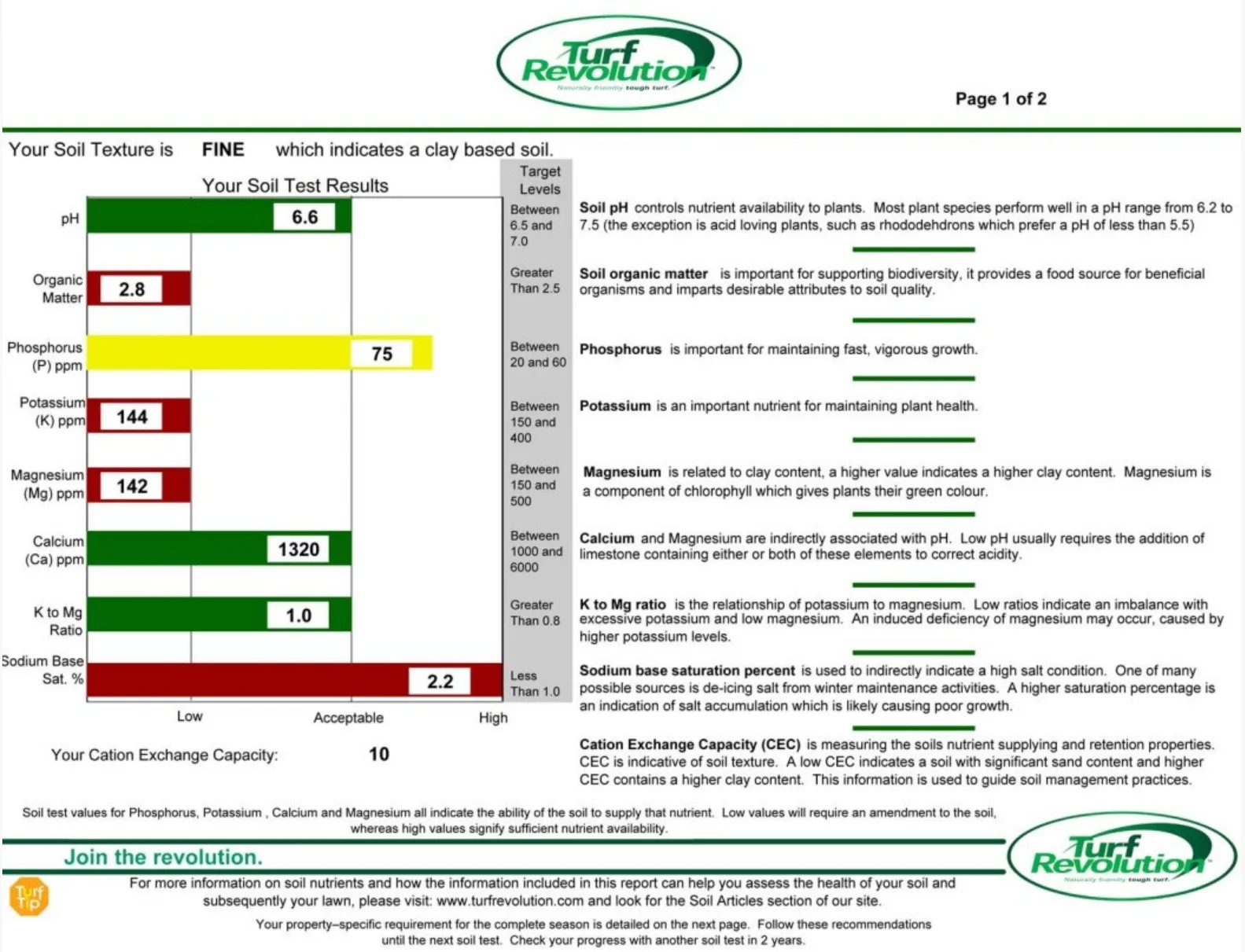
| Measured | Result | Target | What it means |
|---|---|---|---|
| Soil texture | Fine | — | Clay based. Most of this city is. |
| pH | 6.6 | 6.5 – 7.0 | In range. No lime needed here. |
| Organic matter | 2.8% | above 2.5% | Over the line by a hair — the lab still called it low and asked for topdressing. |
| Phosphorus | 75 ppm | 20 – 60 | Already over. More would be wasted, and phosphorus runs off into waterways. |
| Potassium | 144 ppm | 150 – 400 | Short. Potassium is what carries turf through drought and winter. |
| Magnesium | 142 ppm | 150 – 500 | Short. It sits at the centre of the chlorophyll molecule — this is colour. |
| Calcium | 1,320 ppm | 1,000 – 6,000 | Plenty. Ontario soils above pH 5 usually are. |
| Sodium base saturation | 2.2% | under 1.0% | More than double the ceiling. The lab names de-icing salt as a likely source. |
The lawn nobody would have diagnosed by eye.
The two things people reach for first — lime for the pH, and a general-purpose fertilizer — were both wrong here. The pH was already fine. The phosphorus was already over target, so most bags on the shelf would have added more of a nutrient this lawn already had too much of, and none of what it lacked.
What it actually needed was potassium, magnesium, and organic matter. The sodium reading at 2.2% against a ceiling of 1.0% put a number on something we see all over Ottawa: winter salt from the road and driveway accumulating in the soil until growth suffers along the edges. The lab flagged it independently. We did not have to argue it.
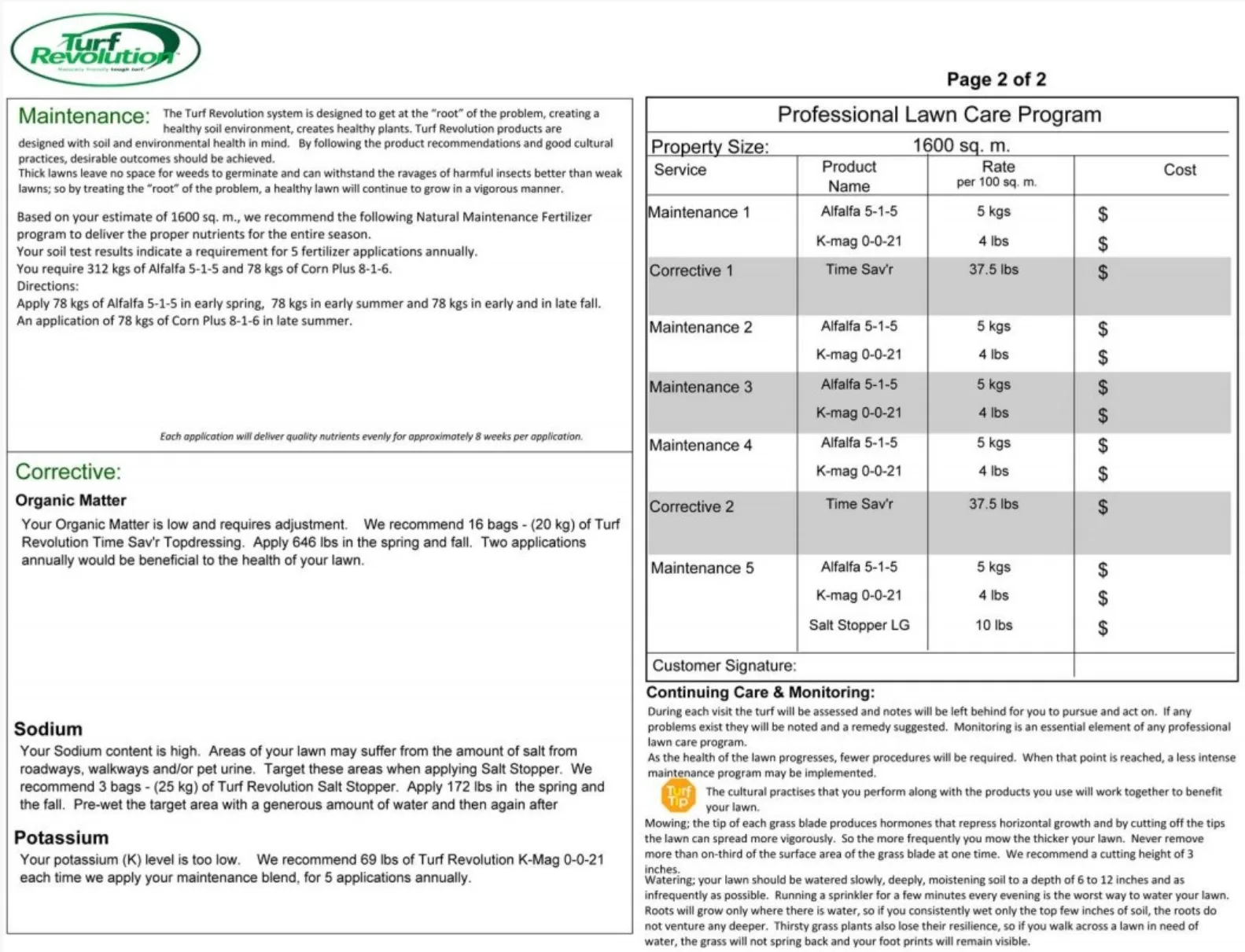
The application schedule printed on page two is that laboratory's own product program, from the year the sample was taken. It is shown here as an example of the detail a test comes back with — not as the program we run today. Ours is on the fertilization page.
What a soil test cannot do.
Worth saying out loud, because the limits are where the overselling usually happens.
It cannot tell you your nitrogen rate
There is no reliable nitrogen soil test. Nitrate moves too fast, and no lab can predict how much of the soil's organic nitrogen will become available this season. OMAFRA sets nitrogen recommendations by how intensively the turf is managed instead.
Organic matter does not set the feed
An organic matter number is genuinely useful — it tells us whether topdressing is worth doing. It does not tell us how much nitrogen to apply, and anyone using it that way is guessing with a decimal point attached.
Manganese and zinc need pH context
Both are largely governed by soil acidity, so their values are only meaningful once combined with pH. Read raw, they mislead. Deficiency is rare in turf; poor aeration raises manganese availability more often than any shortage does.
Some results are foregone conclusions
Calcium is abundant in Ontario soils above pH 5.0, which is most of them — low pH is normally corrected with lime rather than treated as a calcium deficiency. We do not sell tests for questions that already have answers.
Common questions.
How often should a lawn be tested?
Every three years is the general recommendation. Soil chemistry moves slowly — testing annually mostly buys you the same page twice. The exceptions are a lawn that has just been rebuilt, or one where we have changed the pH on purpose and want to confirm it landed.
What comes back in the basic test?
Phosphorus, potassium, magnesium and soil pH — plus texture, calcium, cation exchange capacity and sodium on the report format we use. Manganese, zinc and organic matter can be added when there is a reason to look.
Can a soil test tell you how much nitrogen my lawn needs?
No, and be wary of anyone who says otherwise. There is no reliable nitrogen soil test — nitrate moves too quickly, and nobody can predict what share of the soil's organic nitrogen will become available. OMAFRA's own nitrogen recommendations are based on how intensively the turf is managed, not on a lab number. Organic matter results do not settle it either.
Why not just add a bit of everything?
Because the report above is the normal outcome: two nutrients short, one already over target, and pH fine. A blanket feed would have added more phosphorus to a lawn that did not need it and left the potassium and magnesium exactly where they were. You would have paid for the wrong bag.
Can I buy a soil test on its own?
It goes with lawn work rather than standing alone. We pull the sample while we are already on your property for something else — a program visit, Revive, aeration, or seeding — and that is exactly why it costs $71 instead of what a dedicated trip across Ottawa would have to cost. Book it alongside anything on the lawn side. The report is yours whatever you decide to do next, including nothing, or handing it to another contractor.
Why would I want two tests?
Because front and back are often different lawns. Different sun, different traffic, and the front takes the road salt. If they have never behaved the same way, sampling both is the only way to find out why.